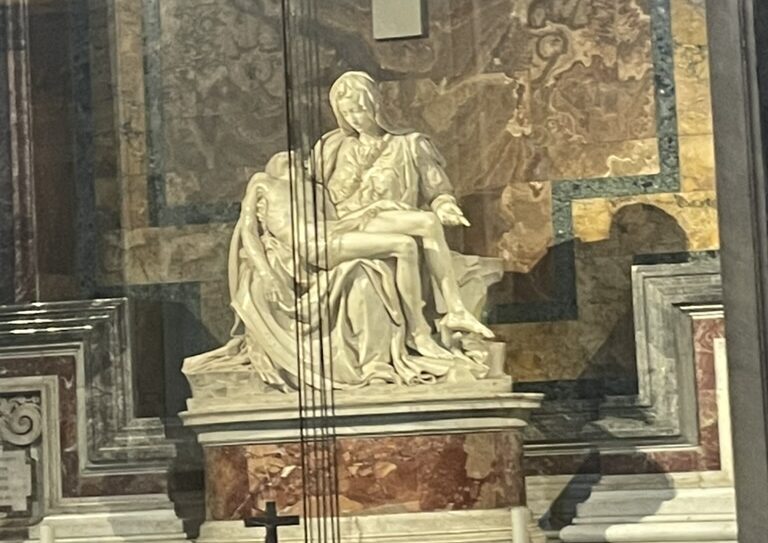
As we attended museums and looked at art this week, one theme I began to recognize was that of the tension between women being both powerful and powerless (in a hierarchical sense). As we looked at Catholic art specifically, (at St. Peter’s Basilica, the Vatican Museums, Basilica San Domenico, and St. Catherine’s Sanctuary), I noticed women in spaces of power. There is a ton of artwork of women in these spaces (especially Mary and female saints) teaching and performing miracles. If they are kneeling or portrayed in a subjugated manner, it is usually towards Jesus. In St. Peter’s Basilica, I noticed that a number of statues of women were placed physically high up in the church, even above some statues of men. I knew that female saints existed, but I previously did not understand the extent to which they have been and are revered (the story of St. Catherine telling the Pope to return to Rome and him complying comes to mind.
However, despite these depictions of women in power, there were also quite a few things I noticed that brought the lower social status of women into focus. Firstly, in each of the places we saw art, I noticed that there were no works by female artists (except those of Wangechi Mutu, the featured East African artist). That means that each of the depictions we saw were from the perspective of men. This caused me to wonder if art done by and from the perspective of a woman might have looked different, and if so, what new insights we might have gained from that worked. Secondly, most of the depictions of women showed them in a habit or with some form of hair covering, which seemed to indicate virginity. Those depicted without hair coverings were usually depicted as being below or overpowered men in some way. The statues of The Rape of Persephone and Apollo and Daphne are of particular note in this way – although they are admittedly depictings of mythology rather than Catholocism, in both a man is attempting to overpower a woman in a sexual way, and in both, the women’s hair is loose. This is not to say that habits or head coverings are oppressive or subjugating in nature – simply that their use in art seems to highlight the condition of women being in power being based on sexual “purity”.
Prompt 3
While in Siena, I gained some great insights about the significance of spaces and community from our education on the districts of Siena. While some people feel loyal to their state or region of the country, this kind of spatial and community identity with the place in which one is born is not common to the United States. Although it is not a feeling I quite understand, I can still sense the degree to which this matters to some people. Acknowledging that difference while still trying to relate to it as I think of the spaces I come from was a great exercise in empathy.
Another experience from Siena that taught me about cultural respect and this practice of empathy was visiting the Basilica San Domineco and the Sanctuary of St. Catherine. In these spaces, it was easy for me to appreciate the size, beauty, and probable effort required to create such spaces. However, I am not Catholic, so I was not quite able to fully appreciate the sacredness of these spaces. However, I was able to understand the worship of Jesus (a point of similarity) and revere St. Catherine as a Christian, powerful woman, and important figure in world religion and history.
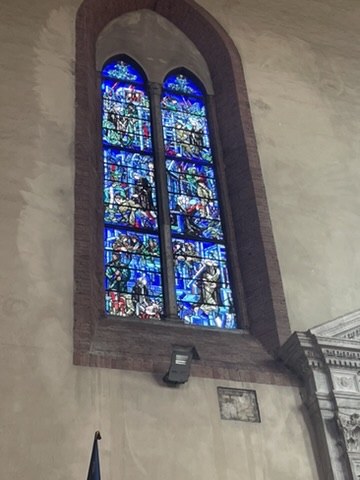
A stained glass in Basilica San Domineco that shows St. Catherine converting a young man before his execution. Although I do not pray to St. Catherine, I recognize her compassion and empathy in this moment as something worth emulating.
Blog 2
Italy Blog 2 - Rome, Procida, Sorrento, Pompeii
Prompt 1
As we toured Pompeii and experienced the exhibit dedicated to women, I was somewhat surprised by the variety in roles women could have in ancient Roman life. I expected that women would have generally been relegated to the private sphere, and while women certainly dominated that space, I thought it was interesting how many of them also fulfilled roles in the public sphere. For example, on our tour we learned about Eumachia, a wealthy woman in Pompeii who ran a very successful textile business. The exhibit explained that Matrons and upper class women could own a variety of different businesses, while lower class women with the skill for it might run a food service. I thought it was interesting that, while women had more options than I had expected, the ways in which they engaged in public life were limited based on both their gender (women did not serve in political or military capacities, rarely worked in occupations such as moneylending) and their socioeconomic standing.
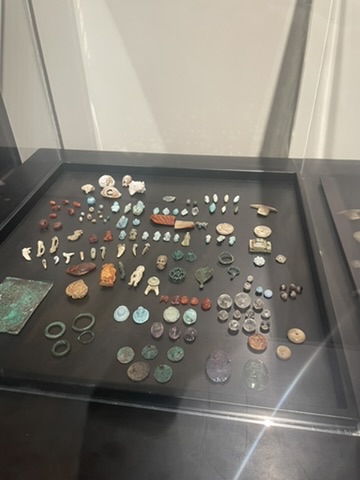
Accessories that might have been sold in a woman-owned shop in Pompeii.
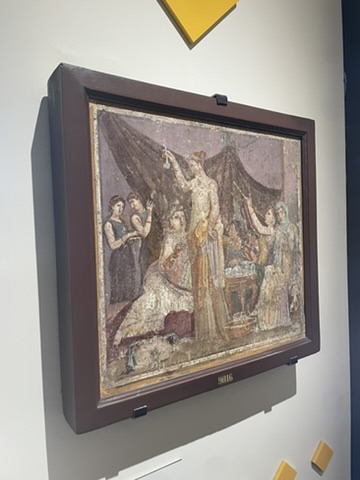
A Matron at a feast.
Prompt 2
One contrast that I think separates how we understand womanhood and power today versus how it was understood in ancient times is how power is derived from roles. In ancient times, women tended to gain power by fitting into certain gendered roles. On Tuesday, we learned about how the Vestal Virgins earned great influence and wealth by committing to a life of virginity and devotion to keeping the flame in Vesta’s temple burning. While in Pompeii, we learned about how many Matrons earned status and took pride in the successful upkeep of their household. Over the past two weeks, we’ve learned about many female saints and nuns, who obtained power and influence through their devotion to religion. In each of these examples, women gained power by fitting into a feminine role. In modern society, I think stereotypically feminine roles are often seen as inherently oppressive. Today, we generally understand power as something gained by breaking away from traditionally feminine roles, rather than by fitting into them. For example, the phrase “women in STEM” is often used to celebrate demonstrations of female power or intellect, as STEM fields are dominated by men. One similarity between the past and present I noticed was the role of intersectionality in women’s access to power. In the past, socioeconomic standing and nationality were notable identities (wealthy women who were native to Rome or Italy tended to have greater access to power). Today, we see this effect with all sorts of identities, including race, sexual orientation, ability, and others.
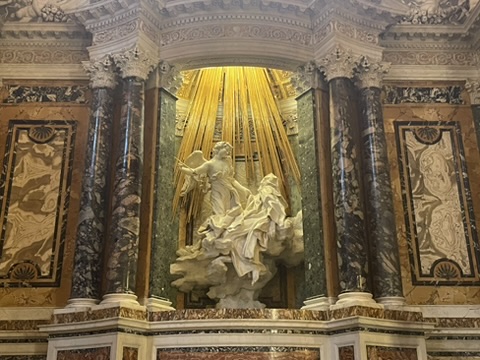
The Ecstasy of St. Theresa
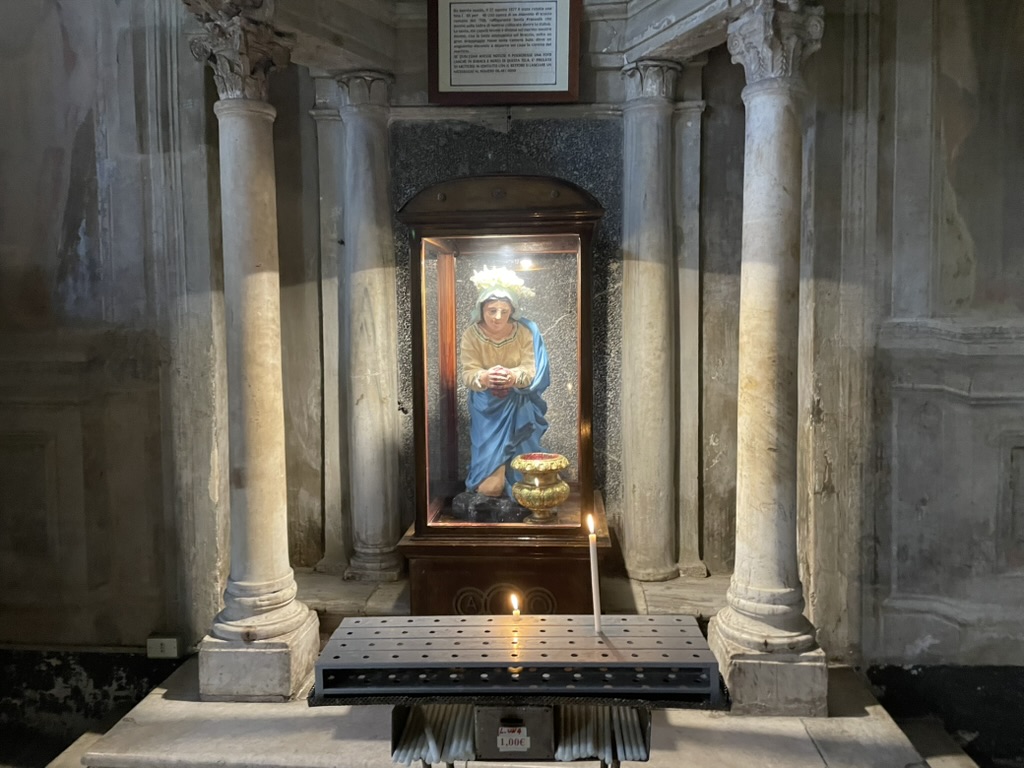
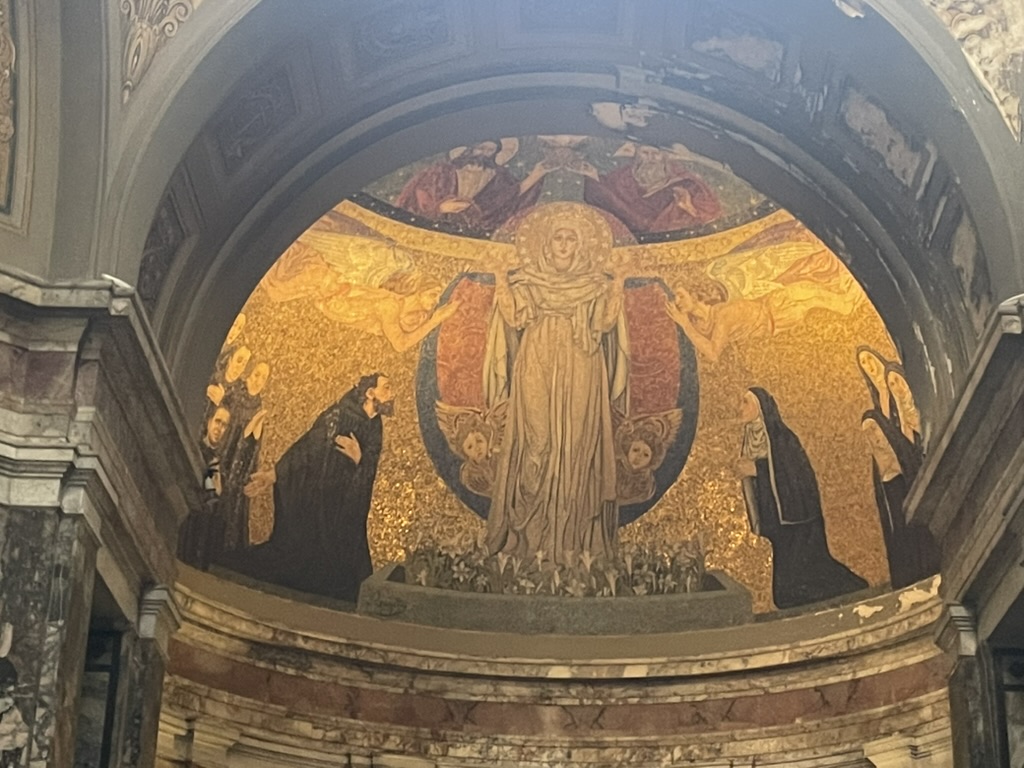
St. Praxedes
Each of these depictions are of women who gained what influence they have; even posthumously, from fitting into a feminine religious role.